 When people talk about Lean Startup, most imagine small, agile teams, rough products, and limited budgets. But a decade of practice has shown: Lean was never meant only for startups. Lean is a learning management mindset in uncertainty — and “uncertainty” is precisely the constant state of large enterprises facing digital transformation, green transition, and supply chain shifts.
Therefore, Lean enters large organizations not through “startup slogans,” but through cycles of fast learning – disciplined decision-making – and evidence-based scaling.
In this article, I share how traditional enterprises can apply Lean to refresh their solution portfolios, test ideas quickly in real markets, and build a culture of innovation — and outline how KisStartup has partnered with corporations through a “venture client + mentoring” model, including programs with Mitsui Chemicals, Hồ Gươm Group, and other partners.
Lean in Large Organizations: Why It’s Different – and Must Be Different
Startups lack resources so they must learn fast. Corporations have abundant resources but often lack the urgency to learn. The difference lies in accountability structure: every decision affects multiple departments, processes are complex, and reputational risks are high.
That’s why Lean in corporations cannot simply mean “creating an innovation team and assigning them KPI on ideas.” It requires a new architecture:
- Enterprise-level hypotheses: Instead of “Will anyone use this feature?”, the question becomes “Which new growth path has evidence strong enough to justify investment?”
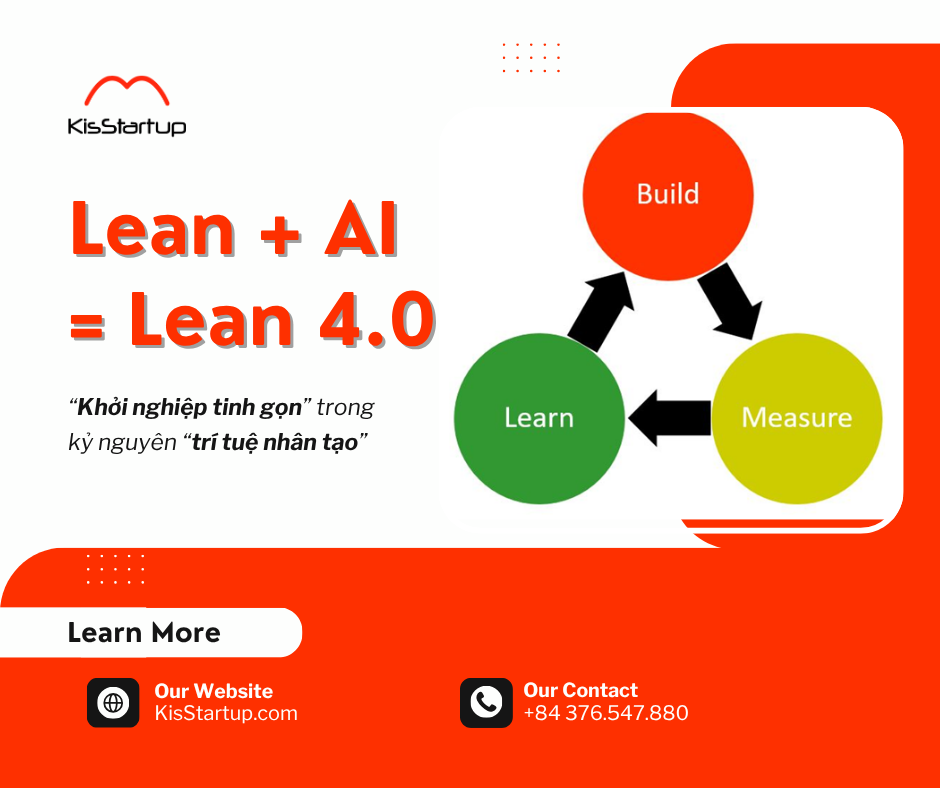
- Safe-to-try domains: Protected spaces where teams can run Build–Measure–Learn cycles without disrupting core operations.
- Innovation accounting: A learning dashboard that ties experiments to financial decision gates.
Without these three pillars, “doing Lean” often becomes internal PR rather than real change.
From Corporate Problems to Real-Market Experiments
Large organizations often start from solutions (buying software, setting up R&D centers), while Lean starts from problems.
Our first step with corporate clients is always to define the problem as a testable hypothesis: identify affected users (internal or external), current behaviors, opportunity costs, and expected market signals if the hypothesis is correct.
Then, project teams must meet real customers — B2B or internal users — to turn the problem into a Meaningful MVP: a value message, a minimal process, or a “good enough to learn” service package.
In corporations, MVPs are not always software; many are trial services, semi-finished products, channel experiments, pricing policies, or new operational configurations. Lean broadens the definition of “product” — and therefore opens the door to new business models.
Case Studies
Mitsui Chemicals: Reverse Pitch & Pre-Investment Evidence
Within the framework of open innovation collaboration, our teams worked with the partner to co-design market–technology problem statements around smart materials, sustainability, chain traceability, and data applications. A typical process includes clarifying downstream value assumptions (who pays, and for what value), building an MVP that is Meaningful–Valuable–Practical, running small pilots with B2B customers in Vietnam or within the regional network, and finally consolidating innovation accounting for the technical–business council to decide whether to “scale or stop.”
What matters most is not whether a single experiment succeeds, but how fast credible evidence is created to support financial decisions.
Venture client model: the corporation presents a real, market-anchored “open problem” (reverse pitch); KisStartup searches, screens, and matches suitable startups/technology teams.
Ho Guom Group: How a Large Enterprise Applies Lean Startup in Its Own Operations
Ho Guom Group offers an illustrative example of how a large enterprise can adopt the Lean Startup mindset—not only to optimize processes but also to learn quickly and improve continuously.
Through the “bridge” created by the VNU Center for Knowledge Transfer and Start-up Support (VNU-CSK) and KisStartup, the Vietnamese partner of the LIF Global Program, Ho Guom Group opened its real operational challenges to external experts, inviting scientists to jointly “work the problem” using a Lean approach: start from a concrete issue, identify feasible solutions, run small, safe-to-fail experiments, measure results, then adjust.
From this series of exchanges, nine innovators collaborated to discuss, analyze root causes, and propose solutions that could be trialed quickly and at low cost. Notable suggestions included installing sensors to detect overload points on the production line to flag congestion early, and introducing an internal barcode system to trace and measure each product’s path during manufacturing.
Ho Guom Group representatives appreciated this “lean” approach, noting that the proposed ideas were practical, testable, and ready for immediate piloting—well aligned with the group’s ongoing digital transformation and process optimization journey.
From a Lean Startup perspective, this was not merely a “technology consulting session,” but a complete learning loop—a moment where a large enterprise actively practiced an “open” culture, learned from small errors, and gradually embedded innovation into everyday operations.
Other Programs: From Digital Transformation to Green Export
Across KisStartup’s different program components (inclusive digital transformation, green-export business model innovation, and institute–industry technology linkage), Lean serves as the learning contract: businesses commit to 2–3 real experiments, at least one shared leading indicator (e.g., “7-day return-customer rate,” “cost-to-serve per order”), a learning log after each cycle, and paired mentors to resolve “people bottlenecks.”
Once data begins to flow, AI and digital platforms finally start to unlock their true value.
Mentoring Inside the Enterprise: Not a Trend, but the Soft Infrastructure of Lean
Many global corporations treat mentoring as an organizational advantage: it shortens learning curves, improves retention, and creates safe feedback loops for experimentation. In Vietnam, embedding mentoring inside enterprises is even more essential because our culture tends to avoid failure—while Lean requires failing the right way.
When designing mentoring programs, we avoid “symbolic” activities. The most effective method is to connect mentors directly with the pilot sprint:
-
Internal mentors (process, legal, finance) ensure experiments do not break the system or stall due to procedures.
-
External mentors (entrepreneurs, technologists, investors) help teams speak the language of the market and see risks/opportunities beyond industry habits.
-
Each mentor–mentee pair signs a simple learning contract: what critical assumption this round tests; what evidence is needed; and what threshold triggers a decision.
When mentoring is tied to real problems and real data, it becomes a mechanism that protects a learning culture: people are encouraged to ask questions, face feedback, and have support when making difficult decisions.
“Enterprise MVP”: Test Small – Measure Fast – Decide Clearly
The MVP concept inside a corporation is different from that of a startup. At corporate scale, “minimum” does not mean “cheapest,” but “just enough to learn with acceptable risk.”
Common and effective forms include:
-
Channel MVP: deploy in one product line, one region, or one time slot to read demand/profit signals before scaling.
-
Add-on service MVP: layer a “thin” service (express delivery, maintenance bundle, personalized consultation) to test willingness to pay.
-
Semi-finished/data MVP: when the market shows demand for components (modules, materials, data feeds), redefine the product—many firms discover new revenue streams this way.
-
Process MVP: alter a single step (authentication, approval, shift assignment) to quantify cost–experience impact.
The core is always innovation accounting: each MVP is tied to one assumption, one leading metric, one go/no-go threshold. Without a learning dashboard, an MVP becomes just “testing for the sake of testing.”
From Product Innovation to Cultural Innovation
Many companies think innovation means launching new products. The more durable innovation is cultural: shifting from “right/wrong by hierarchy” to “right/wrong by evidence”; from “beautiful reports” to “clear lessons”; from “KPI must win” to “disciplined learning.”
Examples include:
-
Monday Learning Hour: each unit shares one evidence-based insight from customers/partners.
-
Thursday Experiment Block: 4 hours dedicated to micro-tests with basic measurement and a sponsor.
-
Friday Reflection: What did we learn? What surprised us? What is the one thing we will change next week?
These routines are cheaper than any “innovation mindset workshop,” yet they build the organizational habit of learning—essential for Lean to endure.
People Before Technology: A Repeated Lesson from Pilots
In many consulting cases, companies begin with the expectation that AI will forecast or personalize. Our answer is always the same: yes—but only after data, and data only after people.
Start with a data MVP (single source of truth, defined indicators, learning logs) plus behavioral mentoring (daring to ask, test, and show failure). Once the data muscles and cultural muscles form, any technology becomes effective.
At a municipal service corporation, the indicator “combined-service utilization rate” became the leading metric for restructuring customer experience. By testing in only two sites and one time block, the intrapreneur team demonstrated a double-digit weekly uplift; that small piece of evidence unlocked the budget for full-scale rollout.
The 90–180 Day Roadmap: A Lean Playbook for Enterprises
-
Weeks 0–2: Frame the problem as a testable assumption. One page: who, what pain, current behaviors, opportunity cost, expected signal. Select one leading indicator.
-
Weeks 3–6: Build the MVP (Meaningful–Valuable–Practical). Test small, safely, with clear measurement and branching rules. Assign internal/external mentors.
-
Weeks 7–12: Run 2–3 Build–Measure–Learn cycles. Each ends with a one-page learning memo; decisions are made based on evidence.
-
Months 4–6: Standardize innovation accounting + scale. Turn small wins into playbooks; turn informed failures into a learning library. Build the mentor network and operationalize the three cultural rituals.
Do it right, and the enterprise gains not only better products/pilots, but a team that knows how to learn—the most valuable capability in uncertainty.
Lean as a Learning Contract Between Strategy and People
When Lean meets a large organization, the fastest change is not technology, but decision-making:
from “I think” to “the data shows”;
from “who wins the argument” to “which evidence wins.”
Innovation stops being an event and becomes the weekly rhythm of the organization.
KisStartup believes in a simple but powerful formula: a well-defined open problem + meaningful MVP + shoulder-to-shoulder mentoring + disciplined innovation accounting. With Mitsui Chemicals, Ho Guom Group, and many other partners, this disciplined cycle reduces investment risk, accelerates market entry, and—most importantly—builds a learning culture where innovation is not a project, but an organizational capability.
Lean began as a startup method. In large enterprises, Lean becomes a learning contract between strategy and people. And when that contract is written in evidence, the organization will always find the right answer—even when the world changes the question every day.
© KisStartup. All rights reserved. Any reproduction, quotation, or use requires proper attribution to KisStartup.