Afternoon Tea with KisStartup - When Heritage Becomes the Core of a Tourism Business Platform
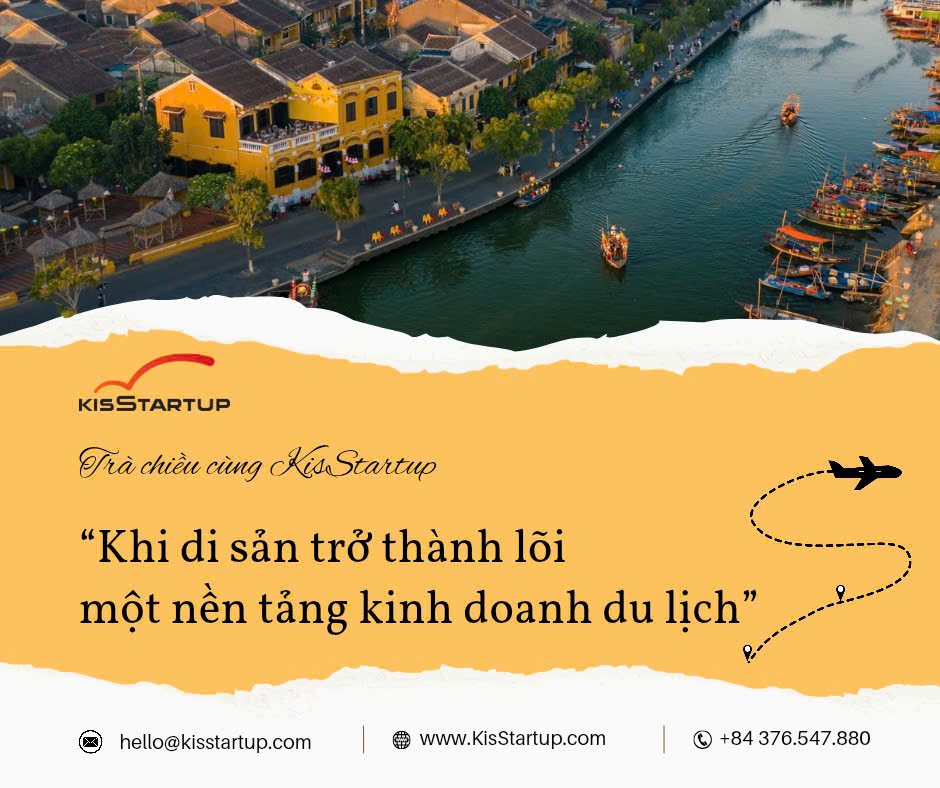
In many recent conversations with tourism enterprises, one recurring question emerges: “How can we leverage culture and heritage without falling into the trap of superficial performance?”
The answer, upon closer examination, does not lie in merely “adding cultural elements,” but in positioning heritage where it truly belongs: at the core of the business model.
A compelling case is the “Hoi An Memories” model—where heritage is not simply narrated, but designed into a central product, and then expanded into a full-service ecosystem. The key takeaway is not its scale, but its mindset: productizing heritage into a platform.
Heritage as Business IP (Intellectual Property)
Traditionally, heritage has been treated as a static resource: ancient towns, craft villages, festivals. Businesses operate around it—selling tours, guides, or accommodation.
In a new model, however, heritage is viewed as intellectual property (IP)—a story that can be reconstructed, designed, and packaged.
Hoi An Memories does not sell the old town itself; it sells a 400-year narrative, staged with clear structure, emotional flow, and controlled experience. The live performance is merely the entry point, from which an entire ecosystem unfolds: theme parks, recreated craft villages, culinary services, accommodation, and events.
The core principle:
Heritage is no longer a background—it becomes the revenue-generating engine.
Platform Model: From Single Experience to Consumption Ecosystem
At its core, this reflects a platform-based business model:
It begins with a strong “hook”—a signature experience that attracts visitors.
However, profit does not lie in the hook itself, but in extended stay duration and expanded spending.
Once visitors enter the storyworld, they do not just observe—they dine, stay, shop, and participate.
This marks a shift from:
selling standalone products → designing layered customer experiences
In modern tourism economics, value lies not in visitor volume, but in Tourist Lifetime Value (TLV). An ecosystem model naturally extends and maximizes this value.
ESG: From Slogan to Operational Structure
A notable strength of this model is its integration of ESG (Environmental, Social, Governance) principles:
Distributing visitors reduces pressure on core heritage sites
Revitalizing craft villages creates economic outputs for local products
Employing local labor retains value within the community
This highlights a critical insight:
ESG should not be an add-on—it must be embedded in the business model from the start.
When executed properly, ESG does not reduce profitability—it becomes a long-term competitive advantage.
Vietnam’s Challenge: Rich Heritage, Limited Experience Design
Vietnam is abundant in cultural heritage—from the Northwest and Central Highlands to the Central Coast.
Yet, most offerings remain:
- Fragmented experiences
- Lacking cohesive storytelling
- Based on “selling what exists”
This leads to a paradox:
Visitors come once, find it beautiful—but lack reasons to return or spend more.
With a platform mindset, the key question shifts to:
“How can visitors not just visit—but live within our story for 1–2 days?”
Strategic Directions for Tourism Businesses
The transformation does not require massive investment—but a shift in perspective:
Define a strong core narrative
Not a list of cultural elements, but a structured story with a beginning, climax, and resolution.
Design a signature experience
A show, workshop, or immersive journey—with clear emotional and experiential flow.
Build surrounding service layers
Dining, accommodation, retail, learning, and interaction—all integrated within a unified storyworld.
Embed sustainability and community engagement
Not for branding, but to ensure long-term viability and resilience.
A Scalable Direction: Micro Ecosystems
Not every destination can replicate large-scale models like Hoi An Memories. However, smaller, localized versions—micro ecosystems—are highly viable.
In regions such as Ban Lien, Son La, or Ha Giang, a single homestay can evolve into a mini-platform:
- A core experience (tea-making, farming, local culture)
- A storytelling space
- A product line linked to the experience
- A digital content system to amplify the narrative
This is how heritage can be transformed into a scalable business platform, even at small scale.
Heritage is not something to merely preserve and display.
When properly understood, it becomes a powerful economic resource—but only when transformed into well-designed experiences.
The key lesson is not about technology or capital investment.
It is about a fundamental shift:
From selling what we have → to designing experiences people want to live in
When done right, heritage is not only preserved—it is valued, sustained, and shared globally.
© Copyright KisStartup. All rights reserved. Any reproduction or citation must clearly credit KisStartup.