Learning loop

The Data Loop – From an Operational Tool to a Foundation for Competitive Advantage and Startup Opportunities
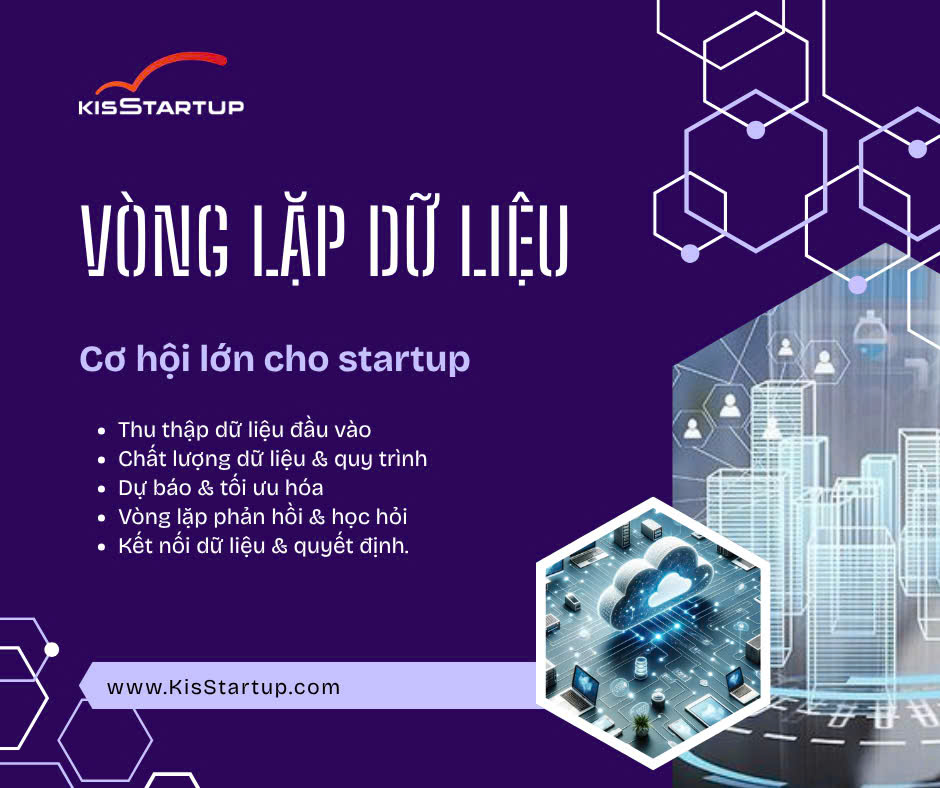
In many organizations, data is often viewed as a “historical report”—used to reflect on what has already happened. However, in modern operating environments, data is no longer just about the past; it forms a continuous learning loop.

This loop distinguishes companies that merely react to the market from those capable of forecasting, adapting, and optimizing in near real time.

More importantly, when examined more deeply, the data loop is not only an internal enterprise matter. It also opens up a vast space for startups to build new products, services, and business models.

When Data Becomes a Learning Loop

A data-driven operating system follows a clear logic:

Decision → Execution → Data collection → Comparison with forecast → Adjustment → Next decision.

This is the learning loop.

For example, a retail company forecasts product demand for the coming week. After execution, it records actual sales and compares them with the forecast. If there is a significant deviation, the company analyzes the causes—promotions, weather, or changes in customer behavior. These insights are then fed back into the system to improve future forecasts.

In logistics, each delivery generates data: delivery time, cost, and delays. When this data is used to update route optimization models, the system becomes increasingly efficient over time.

In workforce management, data on productivity, task completion time, and training effectiveness enables organizations to adjust staffing and training plans based on reality rather than assumptions.

The key point is this: the value lies not in a single analysis, but in the ability to continuously learn from data.

Common Pitfalls That Break the Data Loop

Although the concept of a data loop is not new, very few organizations implement it effectively.

The most common mistake is stopping at reporting.
Companies collect data and build dashboards but fail to use insights to adjust actions. Data becomes decorative rather than actionable.

The second mistake is not measuring forecast error.
Many organizations produce forecasts but do not track deviations between forecasts and actual outcomes. Without understanding errors, the system cannot improve.

The third mistake is failing to capture outcome data.
Organizations implement marketing campaigns, pricing changes, or workforce adjustments but do not systematically measure results. The loop breaks at its most critical point.

The fourth mistake is lacking mechanisms to update models and processes.
Even when feedback data exists, without structured processes to update models or adjust operations, the system cannot evolve.

Real Value: From Operational Optimization to Competitive Advantage

When the data loop is properly implemented, organizations not only improve efficiency but also build sustainable competitive advantage.

First, errors decrease over time. Each iteration allows the system to learn and reduce variance, lowering both cost and risk.

Second, decision-making speed increases. Organizations can adjust operations in near real time instead of waiting for periodic reports.

More importantly, companies gain deeper insights into customers, operations, and markets—insights that competitors cannot easily replicate without similar data systems.

A Major Opportunity for Startups: Building the “Data Loop Infrastructure”

From a startup perspective, the data loop presents a significant opportunity.

Most organizations today lack the capability to build and operate such loops. This gap creates space for startups to participate.

1. Data capture startups – capturing input data
Many companies lack sufficient or granular data. Startups can build solutions such as:

POS, CRM, and ticketing systems
IoT solutions for manufacturing and logistics
Workforce activity tracking tools
This layer represents the entry point of the data loop.

2. Data quality & data pipeline startups
Having data that cannot be used is a common problem. Startups can provide:

  • Data cleaning tools
  • Standardization and synchronization systems
  • Data integration solutions across platforms
  • This is the foundational layer enabling analytics.

3. Forecasting & optimization startups
Once data is ready, the next need is prediction and optimization:

  • Demand forecasting
  • Workforce optimization (e.g., WorkGenda)
  • Inventory and logistics optimization

The value lies in aligning models with real business problems.

4. Feedback & learning loop startups
This is one of the most underdeveloped layers. Startups can build:

  • Forecast error tracking systems
  • A/B testing tools for operations
  • Decision performance monitoring platforms
  • These solutions help “close the loop.”

5. Decision intelligence startups
At a higher level, startups can go beyond data delivery to recommend actions:

“Increasing evening shift staffing by 10% will reduce wait time by 15%.”
“Reducing price by 5% increases revenue by X but reduces margin by Y.”
This layer connects data directly to decisions.

How Enterprises Can Start Building a Data Loop

Organizations do not need complex systems to begin. A practical approach includes:

Step 1: Select a key decision to ‘datafy’
For example:

Inventory purchasing decisions
Workforce scheduling
Marketing execution

Step 2: Capture data before, during, and after the decision

Before: forecasts, assumptions
During: actual actions
After: outcomes

Step 3: Compare and measure error

Forecast vs. actual
Expected vs. realized results

Step 4: Extract insights and adjust

Were errors due to data or assumptions?
Are there recurring patterns?

Step 5: Repeat and standardize the process
After several iterations, the organization develops a true learning system.

Those Who Learn Faster Will Win—and Startups Enable Faster Learning

In a rapidly changing world, competitive advantage no longer lies in who has more data, but in who learns faster from it.

The data loop is the mechanism that enables organizations to learn.

And the gaps in building and operating this loop represent a major opportunity for startups—not only to provide technology, but to become part of the “nervous system” that helps enterprises make better decisions every day.

© Copyright belongs to KisStartup. Any reproduction, citation, or reuse must clearly credit KisStartup as the source.

Author: 
KisStartup

Lesson 11. Lean Storytelling: When Lean Startup Meets Product–Service Marketing

In marketing, people often begin with the question: “What story should we tell to make it compelling?” With the Lean Startup mindset, I would switch the order: “Which story has been validated to truly resonate with what customers are seeking?” When we change the question, the approach also shifts: instead of writing a grand narrative about the brand, we design small experiments with messages, usage scenarios, social proof, and calls to action; we measure responses like researchers, letting data guide us to the right story.

Three building blocks form what I call “lean storytelling”: human touchpoints, numbers that speak, and learning loops. When these pieces turn in sync, they transform ordinary words into real revenue—and more importantly, sustained trust.

Human Touchpoints: Stories Begin with Real Moments

Every product–service story should be anchored in a concrete moment: where the customer is, what they are facing, what frustration or expectation arises. At KisStartup, we often open our notebooks right after an interview to capture the customer’s “golden quote.” A homestay owner once told us: “I’m only afraid customers will say it looks nice but not like the photos.” We used that exact line as the headline for an interior service landing page: “Beautiful like the photos—only more durable.” Not fancy words, just authenticity.

Lean storytelling is not about polishing the product—it’s about returning real life to the words. If a customer says “easier on my hands,” don’t rewrite it as “optimized operation.” If they sigh with relief because they “no longer have to watch the clock to collect payments,” don’t dress it up as “improved cash flow.” Keep the raw texture of life, then add a minimal proof point: a before–after photo, an on-time invoice screenshot, a 12-second clip of real usage. The story gains weight because it preserves traces of reality.

Numbers That Speak: Every Story Needs a Measurement Lever

A good story evokes emotion. A correct story demonstrates changed behavior. Lean forces us to attach each content piece to a single measurable goal: booking a call, leaving a phone number, downloading a document, adding to cart, returning to purchase. I appreciate how small numbers lead the way.

Start with two versions of the same story: one emphasizing pain points, the other highlighting the desired future. Put them on two almost-identical landing pages—only the headline and intro differ—and split traffic for 48–72 hours. If the “pain point” version yields a 6.3% form-fill rate compared to 3.8% for the “future scenario” version, you have your first answer: customers respond more strongly to problem-solving than dreamy futures. But don’t stop there; examine the quality of the conversions—call duration, booking rate, questions asked. Numbers don’t replace listening, but they help you prioritize what to listen to.

Thin but useful indicators keep the story tied to behavior: time spent reading to 75%, save–share vs. like ratios, direct traffic percentage two weeks post-launch (a signal of brand recall), conversion rate of viewers who reach second 10 of a video, number of branded keywords searched after a campaign. You don’t need dozens of dashboards—just a few clear curves to make decisions.

The Learning Loop: Write – Measure – Adjust – Rewrite

Each story is a content MVP. Don’t wait for perfection—run through the loop instead. Day 1: publish a 250-word story about a “pain-trigger moment.” Day 3: based on responses, create a real-use video incorporating the customer’s exact quote and add subtitles. Day 6: write a 600-word case with post-use numbers. Change only one element per loop—headline, timeline, call to action, or social proof. Changing one variable at a time reveals what actually moves the needle.

Choose the right format for each story: “hear–see” fits short videos; “before–after” fits carousels; “benefit calculation” fits landing pages with savings tables. When a story shows traction—price inquiries, inbox messages for samples, email replies—archive it as a long-term asset: add it to your Customer Stories page, sales deck, or team training materials using the exact customer language.

Practice: Build a Lean Story Frame in One Afternoon

Suppose you sell a revenue–expense management solution for homestays. Start with one real person. Call them and ask three questions: “When was your last late payment?”, “How did you handle it?”, “What do you most fear repeating?” Keep the one quote that makes you sit up—use it as the opening line. Then describe the usage situation in 4–5 simple lines—no hype. Add minimal proof: a reconciled report screenshot or a message saying “no more watching the clock.” End with a small action: “Book a 15-minute demo—we’ll use your actual data.”

If possible, add a before–after metric over 14 days: “Late payments dropped from 7 to 2; average collection time decreased from 41 to 26 days.” Don’t claim “37% time saved” unless you’ve actually measured it; say exactly what’s true, then promise to update in 30 days. Marketing becomes not a promise, but a shared improvement journal.

Balancing Story and Data: Don’t Let Numbers Dry Out Words, or Words Blur Numbers

The trap in marketing is either “measuring by feeling” or “measuring everything.” Lean teaches focus: if this month’s objective is onboarding 20 new B2B clients, track three indicators—appointments from stories, appointment-to-trial rate, trial-to-contract rate. Let stories serve these ratios: open with copy that gets appointments, use short cases to secure trials, and simple ROI tables to close contracts. Numbers become the heartbeat of the words.

Conversely, don’t let words drown numbers. If a story performs well online but doesn’t appear in the CRM as “appointments,” ask: is the call to action clear? Is the timeline specific? Is the booking page mobile-friendly? A small tweak—from “Contact us for more info” to “Book a 15-minute demo with your data”—can move the numbers.

Ethics of Storytelling: Honesty, Respect, and Anti-Impact-Washing

The best stories are true stories. When using community data (artisans, farmers, patients…), ask permission, explain the purpose, credit contributors, share benefits. When discussing social or environmental impact, separate outputs from outcomes: training sessions don’t equal increased income; trees planted don’t equal restored biodiversity. Marketing may soar, but its wings must be stitched with honesty.

Two Examples, One Principle
Example A – “Pain Relief” Rhythm (B2B)

“Three late payments in a month made Ms. Hoa dread phone calls. ‘I hate the line “tomorrow, please,” when tomorrow never comes.’ After 14 days using automated revenue–expense tools, late payments dropped from 7 to 2, collection time decreased from 41 to 26 days. She said: ‘I no longer have to send reminders. The system does it—I don’t have to be the bad guy.’ Want to see a sample report using your data? Book a 15-minute demo—no commitments.”

Example B – “Future Vision” Rhythm (B2C)

“Minh roasts coffee and believes his beans ‘carry the highland spirit,’ yet online sales stagnate. ‘I want customers to drink it and immediately want to tell a friend.’ We suggested something simple: capture the exact dawn moment of roasting the first batch—keep the lid pop, keep the laughter. In a 58-second video, 42% watched to second 30; trial orders rose 2.1× week-over-week; 27% bought a 500g bag within 10 days. Minh said: ‘Maybe I should stop being philosophical and let customers hear real life.’ Do you have 90 spare minutes? Let’s build a 58-second story together.”

Both examples rest on one principle: real voice, real scenes, real numbers, small calls to action.

Embedding Lean Storytelling into the Organization

Once the team sees lean storytelling’s value, turn it into habit. Weekly: choose a real-life moment. Monthly: choose one vital metric. Quarterly: host a “word surgery” session to analyze high-converting stories and why. Store quotes, screenshots, and raw videos in a shared folder—name files by date–channel–goal. In just a few months, you’ll have a rich internal library enabling sales, customer service, and product teams to speak the same language: the customer’s language.

Write Less to Sell More

Lean storytelling isn’t about writing fewer words—it’s about removing words that don’t matter. When we center people, let numbers guide us, and honor the learning loop, marketing becomes less flashy, less generic, and more grounded. Customers don’t need us to be perfect—they need to feel understood, see us experiment, measure, improve. The story becomes not a poster but a handshake: warm, concise, trustworthy.

If you want one exercise for this afternoon: call a past customer, ask permission to record one honest moment of frustration—or joy—when using your product. Write 200 words around that quote, add a small proof, publish it with a specific call to action. Check numbers three days later. You may discover you weren’t missing a “big idea”—just two small metrics and one true sentence.

© Copyright belongs to KisStartup. Any copying, quoting, or reuse must cite KisStartup as the source.

Author: 
Nguyễn Đặng Tuấn Minh