
Innovation and Entrepreneurship 5 minutes a day: Startup book: The Hard Thing about Hard Things – Part 2 – Care about people, then product, then profit
 If in Part 1 (When everything starts to fall apart), you saw how to respond when a business faces crisis, then in Part 2, let’s dive into the root of sustainability for an early-stage organization like a startup – People. You may find many ideas here go against the traditional belief that you need money first before building company culture or investing in employees. Ben points out that it should be the other way around: good people create good products, and then profit will follow.
The Hard Thing about Hard Things – Part 2 – Focus on People, then Product, then Profit
If your company becomes a dream place to work, you’ll stay longer in success.
A great place to work
You only realize the importance of creating an ideal work environment when things go wrong. And as you know, things rarely go right.
When everything’s going well, there are plenty of reasons for employees to stay. But when things start to fall apart, those same reasons can become the reasons they leave. So, start by focusing on people.
Why startups should develop talent
Most tech companies understand that people are their most important asset. In the early days, startups tend to focus only on hiring and interviews to build a talented team—and stop there. Here are 4 reasons why that’s not enough:
- Productivity – Want your employees to be productive? Then train them to be productive.
- Performance management – Set clear goals throughout training to track and manage work performance.
- Product management – When a team works together on a product, train all members to align with the end goal so they can collaborate effectively.
- Retention – A major reason people leave is lack of guidance, growth opportunities, or feedback to improve themselves.
Why it’s hard to hire big-company employees for small startups
Remember, the job of an employee at a big company is very different from that at a small one. In a startup, nothing happens unless you make it happen. In the early days, you need to come up with dozens of ideas—or the company dies. If you don’t push, the company stalls. In big companies, the work is already laid out—you just sit and do it.
When hiring someone from a big company, there are two main risks:
- Mismatch in pace – They’re used to waiting for emails, calls, and scheduled meetings instead of getting out and creating work.
- Mismatch in skill – Big company skills often focus on prioritization, organizational design, improving processes, making hard decisions, etc. But in a young startup, there are no processes to improve. You need a whole different skill set.
To avoid this, screen carefully during the interview. Be clear about expectations. Ensure the transition from big to small company is smooth, and always communicate openly.
Hiring talent: If you’ve never done it, how do you hire great people?
Know exactly what you’re looking for. Observe and sense. Identify talent from a sea of candidates. Evaluate weaknesses—not just strengths.
Write out the process to find the right fit. List the strengths you want and the weaknesses you can accept. Use these as your hiring criteria. Build a question set to test them. Form an interview team to help you. Also, cross-check with the candidate’s references. In the end, make the final call yourself. Hire the one YOU believe fits best.
When employees don’t understand management
Managers are easily misunderstood. To avoid this, understand that everything you do affects employee behavior. Once you know the outcome you want, check if your actions lead employees in that direction. If not, it may backfire—worse than the original problem you were trying to solve.
Ensuring management quality
A good HR team supports, measures, and improves your management. To build this, note the following:
- Be a true diplomat – No one likes a loudmouth, and no HR team works well without the trust of top leadership.
- HR knowledge – Compensation, benefits, hiring policies change quickly. HR leaders must stay updated.
- Capacity to be a trusted CEO advisor – It means nothing if the CEO doesn’t support HR’s efforts to ensure management quality.
- Understand what’s never said – When management quality declines, regular employees won’t say anything—but savvy ones will warn you the company is slipping. You need people like that.
Be alert to potential issues
As companies grow, they change. No matter how strong your company culture or spirit is, things won’t stay the same when you scale from 10 to 1,000 or even 100,000 employees. But that doesn’t mean you can’t keep it a great place to work. It just changes. Accept this and steer things in the right direction.
Minimize internal conflict
First, hire people who share the ambition—for company success, not just personal gain. Second, create strict processes for resolving conflicts, especially in areas like performance reviews, compensation, and promotions. These can easily trigger conflict. As CEO, you must understand how every word and action affects people. Be open and empathetic, but also careful not to encourage negativity.
Titles and promotions
Why talk about titles? Because every employee wants to know who they are and what they do. You might think focusing on promotions and titles is superficial. But without a thoughtful process, people will feel unfairly treated. If you design it well, nobody but you will spend time thinking about the “Employee of the Month” title.
Building company culture
Culture doesn’t build a company. Many companies with great cultures still go bankrupt. So why care?
- Culture helps you achieve the goals above.
- As your company grows, it preserves your core values, makes your company a better place to work, and improves future operations.
- Once you and your team succeed in building a company, the culture keeps everyone engaged and moving forward.
Translated by Tạ Hương Thảo – Capacity Building Program Coordinator at KisStartup.
Source: Paul Minors
KisStartup realized that reading a full book isn’t always possible for startup founders. That’s why we needed a more effective summary—one that’s careful, concise, and delivers key messages. With the recommendation of mentor Phan Đình Tuấn Anh from SME Mentoring 1:1, we found Paul Minors, who curates thoughtful summaries. With Paul’s permission, we selected books best suited for startups. KisStartup’s team read the originals to ensure alignment, then translated them into Vietnamese. In 2018, we introduced these books section by section, designed for a 5-minute read each time.
The Hard Thing about Hard Things is the first book we chose to introduce because we saw in it a deep sense of empathy with startups—timeless stories about people and how they respond to the challenges and temptations that come with building something new. Starting a business is full of difficulties and demands extraordinary effort. Ben Horowitz delivers concise messages, reminding us of essential things we often overlook.
While reading, I realized something: company culture often forms from the personal growth of the startup founder—transforming from a startup founder into a business owner who creates real value.
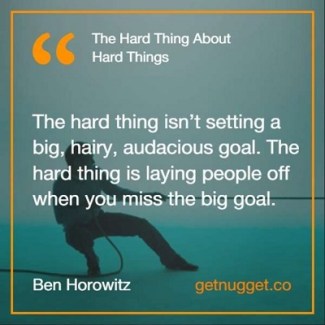
The book was translated by my colleague at KisStartup, Tạ Hương Thảo – Capacity Building Program Coordinator at KisStartup. I hope, like me, you find value in this book. As the author Ben Horowitz said: “The hard thing isn’t setting big, challenging, audacious goals. The hard thing is having to fire people when you fail to hit those big goals.”
So how do we build a vision together, become a true CEO, and maintain the perseverance needed on the path of creating value? Let’s read, discover, and put it into practice.
— Nguyễn Đặng Tuấn Minh, Manager & Co-founder of KisStartup
Entrepreneurship – Corporate Innovation,
KNOWLEDGE FOR ENTREPRENEURSHIP & INNOVATION EDUCATION,
KNOWLEDGE FOR STARTUPS,
Startup Books,
Startup Mindset