German Technologies Being Imported into Vietnam: From Precision Machinery to Green Transition
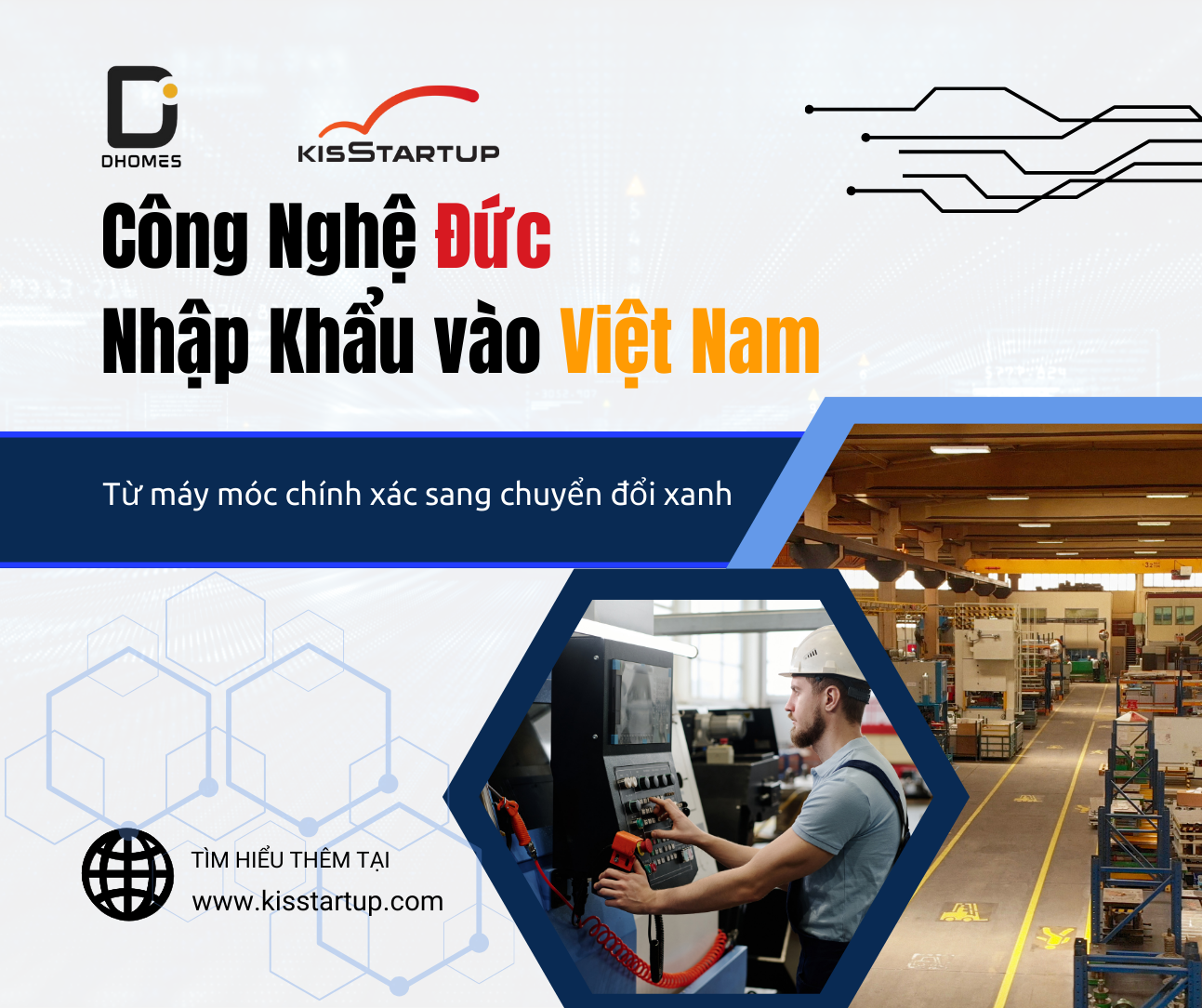
Over the past decade, Germany has consistently ranked among Vietnam’s most important technology partners. Beyond being one of Europe’s largest trading partners, Germany is widely regarded as a “gold standard” for industrial technology, precision engineering, and sustainable development solutions. German technologies imported into Vietnam may not be flashy or trend-driven, but they steadily shape the country’s manufacturing capabilities, management practices, and green transformation across multiple economic sectors.
From KisStartup’s perspective, the key value lies not in the volume of imported equipment, but in the technological logic that comes with German solutions: high standards, long lifecycle, resource optimization, and a strong connection between technology and human capacity building.
Mechanical Engineering and Manufacturing: The Backbone of Vietnam’s Industry
One of the earliest and most deeply embedded German technology groups in Vietnam is mechanical engineering and manufacturing. German CNC machines, metal processing equipment, molds, and precision measurement systems are widely used in automotive, motorcycle, electronics, tooling, and supporting industries.
Their strength lies not only in precision, but also in long-term operational stability—well suited for Vietnamese factories transitioning from basic processing to higher value-added, technically sophisticated manufacturing. Many Vietnamese enterprises report that while initial investment costs are higher, the total cost of ownership over the equipment’s lifecycle is significantly lower compared to cheaper alternatives.
Automation and Industry 4.0: Importing Mindsets, Not Just Hardware
Alongside machinery, Vietnam is increasingly importing German automation and factory digitalization solutions: control systems, industrial sensors, production monitoring software, energy management systems, and predictive maintenance tools.
Notably, German technology integrates hardware and software seamlessly, embedding an Industry 4.0 philosophy where data serves real production decisions rather than mere reporting. This approach is particularly relevant for Vietnamese manufacturers facing skilled labor shortages and growing pressure to improve productivity.
Renewable Energy and Energy Efficiency Technologies
Germany is a global pioneer in energy transition, and its technologies have been increasingly imported into Vietnam over the past 5–7 years. These include wind turbines, solar power equipment, energy storage systems, and solutions for optimizing electricity consumption in factories and buildings.
For Vietnam, the greatest value lies not only in the equipment itself, but in system integration—how renewable energy is embedded into existing infrastructure to reduce long-term costs and meet increasingly stringent emission requirements from EU markets.
Environmental Technologies: Water, Emissions, and Circular Economy
Another fast-growing category of German technology imports involves environmental solutions for water treatment, air pollution control, and industrial waste management. These include wastewater treatment systems, water reuse technologies, dust filtration, toxic gas treatment, and waste heat recovery, applied across industrial parks, food processing, chemicals, textiles, and energy sectors.
From a sustainability perspective, German technologies help Vietnam move closer to a circular economy model—where waste is not merely treated, but recovered and transformed into new value such as energy, reusable water, or secondary raw materials.
Agricultural and Food Technologies: Standardization and Safety
In agriculture and food processing, Vietnam imports numerous German processing lines, cold storage systems, quality control technologies, and food safety solutions. These are critical for Vietnamese enterprises seeking access to European markets.
The strength of German technology lies in process standardization—from harvesting and preprocessing to deep processing, packaging, and traceability—enabling Vietnamese agricultural products not only to “enter” international markets, but to remain competitive over the long term.
Vocational Training and Skills Transfer: A “Soft Technology” with Hard Impact
One of the most influential “soft technologies” Vietnam is importing from Germany is the dual vocational training model. Through cooperation projects, Vietnamese enterprises and vocational schools adopt training approaches closely linked to real production environments, strict labor discipline, and high technical standards.
From a long-term perspective, this is a decisive factor ensuring that imported technologies do not remain “black boxes,” but are gradually localized and mastered through human capital.
Implications for Vietnamese Enterprises and Local Governments
Overall, German technologies imported into Vietnam focus on three core pillars: enhancing production capacity, improving resource efficiency, and meeting sustainable development requirements. However, significant challenges remain in absorption capacity—investment capital, skilled labor, and management capabilities.
From KisStartup’s viewpoint, Vietnamese enterprises should approach German technology not merely as a procurement decision, but as a long-term partnership: learning how to operate, standardizing processes, and gradually building internal capabilities. For local governments, policies to attract German technology should be accompanied by training support, enterprise–university linkages, and pilot programs for green transformation.
As Vietnam enters a phase of competition driven by quality and sustainability, German technology represents not just a technical option, but a strategic pathway for upgrading the economy—slowly, but solidly.
German technology companies and organizations seeking to expand into Southeast Asia should view Vietnam as a strategic pilot market, where green transition and manufacturing upgrades are accelerating, and where DHomes acts as a trusted partner to reduce market entry risks.
Local governments, industrial zones, incubators, and innovation support organizations can collaborate with DHomes to design pilot technology programs that combine technology transfer, workforce training, and local value chain development.
If you are interested in German–Vietnam technology cooperation, connect with DHomes today to experiment together, learn together, and build long-term partnerships.
© Copyright KisStartup. Any reproduction, quotation, or reuse must clearly cite KisStartup as the source.