IP-backed financing (Part 2): Real-world examples – and what startups can learn
KisStartup – compiled and presented
After understanding what IP-backed financing is, a common question many startups ask is:
“It sounds promising, but has anyone actually done it? And how?”
The answer is yes – and more often than many realize. The following cases show that intellectual property (IP) is not just legal paperwork. In many situations, it has become a real financial tool that helps companies survive, scale, or restructure. More importantly, each case offers concrete lessons for startups.
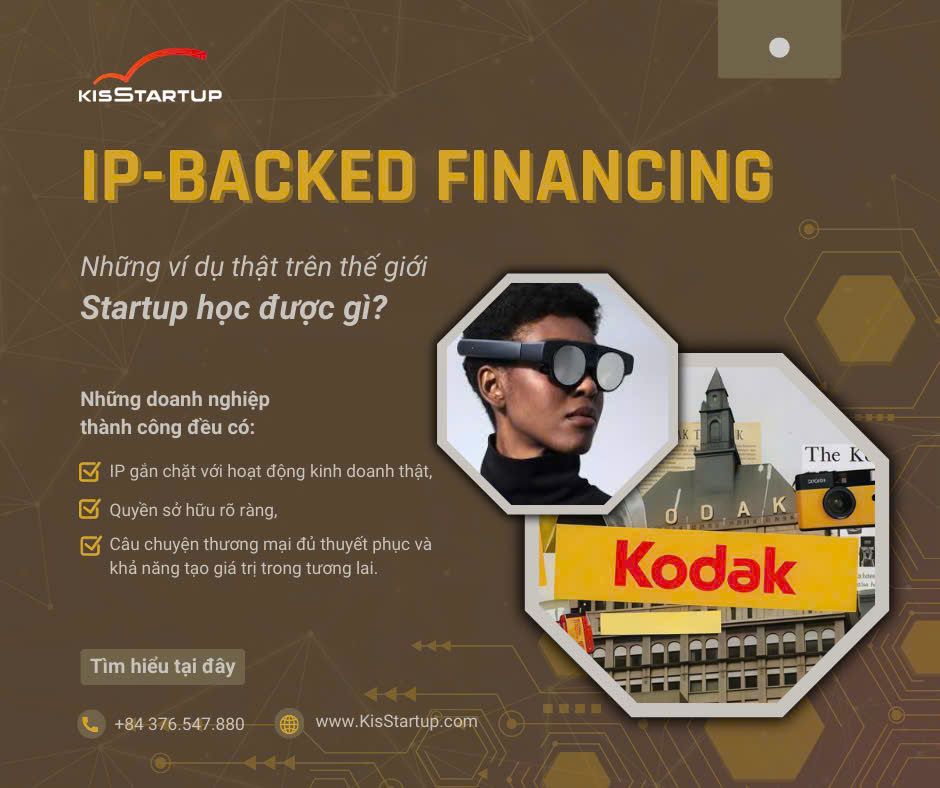
Magic Leap: Using patents as collateral
Magic Leap, an augmented reality (AR) startup that raised billions of dollars, used nearly 2,000 patents as collateral in a financing deal with JPMorgan Chase in 2019.
This did not mean selling the patents. Magic Leap continued to use the technology to develop products. However, the size and clarity of its IP portfolio gave the bank confidence that, in a worst-case scenario, these assets could be licensed or transferred to recover value.
Lesson for startups:
You do not need 2,000 patents. What matters is managing IP as a structured portfolio, not as isolated documents. A well-organized IP portfolio is far more financeable.
Kodak: IP as a financial lifeline
When the film camera market collapsed, Kodak faced severe financial distress and near-bankruptcy. What saved the company was not factories or equipment, but a portfolio of over 1,000 digital imaging patents.
By selling and licensing these patents, Kodak raised approximately USD 525 million, enabling financial restructuring and survival.
Lesson for startups:
IP is not only for growth; it is also a risk buffer. In times of crisis, IP may become the last strategic asset that enables recovery.
Masai: An IP-backed loan saves an SME
Masai, a Singapore-based footwear company, owned patented designs that improved posture and health. When counterfeit products flooded the market, revenues dropped sharply, pushing the company toward bankruptcy.
In 2016, Masai became one of the first companies to access an IP-backed loan under Singapore’s national IP financing scheme. Using its core patent as collateral, the company secured a seven-figure loan, enabling restructuring and renewed growth.
Lesson for startups:
IP-backed financing is not only for big tech. SMEs and early-stage startups with genuinely protected and differentiated IP can access it—if the ecosystem allows.
NatWest: Banks designing IP-based products for startups
In the UK, NatWest Group offers lending products for high-growth businesses where IP is considered part of the collateral base. The bank works with independent IP valuation firms to assess patents, software, and trademarks.
Companies may lack physical assets but must prove that their IP is closely linked to the business model and future cash flows.
Lesson for startups:
When banks understand IP, startups are no longer forced to rely on real estate. In return, startups must demonstrate strong IP governance and transparency.
South Korea & China: When governments unlock IP-backed finance
South Korea has built a national IP valuation system, allowing companies to borrow up to 60–70% of assessed IP value—even with limited credit history. Tens of thousands of technology SMEs have gained access to capital as a result.
In China, patent- and trademark-backed lending has grown rapidly, reaching hundreds of billions of USD. This growth is driven by clear policies, bank incentives, and a national strategy that treats IP as a strategic asset.
Lesson for startups:
IP-backed financing is not only about individual firms. It requires an ecosystem: policy, valuation, insurance, and enforcement. Startups that standardize and manage IP early benefit most when such ecosystems mature.
What should startups take away?
Across all cases, one message is clear: no one secures financing simply by “having IP.”
Successful companies share common traits:
- IP tightly connected to real business activities,
- clear ownership, and
- a compelling commercialization story that convinces lenders of future value.
For startups, these examples are not a promise of immediate IP-backed loans. They are a reminder that IP can become a powerful financing lever—if prepared early and managed correctly.
© Copyright KisStartup. Any reproduction or reuse must clearly cite KisStartup as the source.
References:
Avon River Ventures
Case Studies: Successful IP-Backed Financing Deals
A compilation of notable IP-backed financing transactions, including SMEs and technology startups.
https://avonriverventures.com/case-studies-successful-ip-backed-financin
Reality.News / Public Filings
Magic Leap Patents Signed Over to JPMorgan Chase as Collateral (2019)
Information on Magic Leap using its patent portfolio as collateral in a financing agreement with JPMorgan Chase.
https://www.reality.news/news/magic-leap-patents-signed-over-jpmorgan-ch
BlueIron IP
IP-Backed Lending in Asia
An analysis of IP-backed lending models in Asia, including South Korea, China, and Singapore.
https://blueironip.com/ip-backed-lending-in-asia/
Singapore IP Financing Scheme – Case Masai
Masai as one of the earliest cases to access IP-backed loans under Singapore’s national IP financing program.
Compiled from:
https://avonriverventures.com/case-studies-successful-ip-backed-financin
NatWest Group (UK)
Intellectual Property Finance & High-Growth Lending
Information on lending products for high-growth companies, where intellectual property is recognized as part of the collateral.
https://www.cliftonpf.co.uk/blog/10072024142230-intellectual-property-fi
CNIPA & China IP Today
Statistics on the rapid growth of patent- and trademark-backed loans in China.
https://www.chinaiptoday.com/post.html?id=2243
https://english.cnipa.gov.cn/art/2024/1/24/art_3090_190001.html
WIPO – Country Perspectives on IP Finance
A series of country-level reports (China, Malaysia, etc.) on policies and models for intellectual property finance.
https://www.wipo.int/publications/en/series/index.jsp?id=241