Social Enterprises (SE), although still a debated concept, are undeniably businesses that aim to solve social issues. These two elements harmonize with each other and bring value to both the business and the community. However, unlike traditional startups, social enterprises face challenges a hundred times greater because they must balance the interests of all stakeholders, striving to survive and remain sustainable while not forgetting their commitments to the community.
One of the important reasons why many social enterprises fail is the lack of a sustainable business model. Although most startups in this field are founded with noble goals, such as supporting the community and marginalized groups, the lack of a solid business foundation causes them to struggle. So, how can you take solid steps before deciding to start a social enterprise? Specifically, how will you make money, and who will you impact? How can you get a complete view of the social enterprise you’re building? How do you speak confidently to sponsors and investors?
 |
One of the answers lies in building a sustainable social business model. This is the first essential step before starting any business, and it should be clearly mapped out through the Business Model Canvas for social enterprises.
Starting with the Traditional Business Model
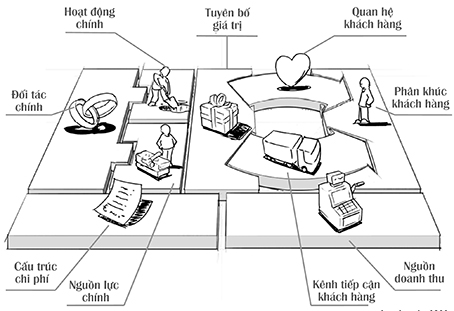
Introduced eight years ago, the Business Model Canvas has inspired many generations of entrepreneurs and businesses due to its simplicity and visual clarity. This model highlights key issues directly related to business operations and the value the business provides. With a Business Model Canvas, all company employees and investors can quickly understand the business approach and model. A Social Enterprise (SE) cannot rely entirely on funding; it also needs a clear business story based on the following nine components:
-
Value Proposition: This is arguably the most important part, as it helps you answer the question: What differentiates you from competitors, and what value do customers perceive from your products or services? To validate your value, you can choose from one of the following 11 criteria: Innovation; Effectiveness; Customization; Problem-solving; Design; Brand/Status; Price; Cost-saving; Risk reduction; Accessibility; Convenience.
-
Customer Segments: You need to clearly identify which customer segments you are targeting within the following types: Mass market; Niche market; Segmented market; Multi-sided platform (e.g., Google provides free search services to internet users but generates revenue from businesses, companies, and organizations that want to advertise for better search rankings). Along with identifying the segment, you should answer the question of how many customers there are in each segment.
-
Channels: There are many different channels, each with different functions. You need to specify which channels you are using or will use to: Raise customer awareness (e.g., advertising channels like Facebook, through customer groups); Help customers evaluate value (e.g., offering product trials); Allow customers to make purchases (online or in-store, etc.); Deliver value to customers (through services, supplementary services, etc.); Provide after-sales support. When building your channel portfolio, you should consider whether these channels are owned by you or in partnership with others, and whether you are directly or indirectly reaching customers (e.g., via partners).
-
Revenue Streams: This is the next important element that you need to clarify to ensure the sustainability of your business model. For social enterprises, in addition to revenue from products or services, the business may also have sources of funding and support, which can also be a significant revenue stream. The key is to clarify where these revenue sources come from, how much they are, and what proportion they represent in total revenue.
-
Customer Relationships: This is where the social enterprise specifies how it maintains relationships with customers—whether through direct personal support, special assistance, self-service, automated services, community building, or co-creating new value.
-
Key Activities: These are the key activities you need to undertake to operate your business model. How do your value propositions, channels, customer relationships, and revenue factors impact your key activities?
-
Key Resources: Human resources, technical solutions, intellectual property, finances, etc., are important assets for the enterprise.
-
Cost Structure: It would be a mistake if the business doesn’t identify the costs associated with the activities and inputs required for the business model to operate.
-
Key Partners: This is where you identify your essential partners for your business model, which could include communities, associations, suppliers, etc.
The Difference for Social Enterprises
For a traditional business, stopping at the nine components is enough to create a complete picture of its business operations. However, to convince sponsors, investors, and the community that you are providing more than just material value, you need to pay special attention to two key elements:
Customer Segments: You need to clearly specify: Who are you creating value for? Who is your most important customer? Sometimes, the buyer is different from the person who directly benefits from your product or service, so you need to specify who the buyer is. In some cases, the user and the buyer are different.
For example: A company producing life-jacket bags for children to address the issue of drowning in flood-prone areas. The direct beneficiaries are the children in the flood zone, but the buyers may be their families, companies, sponsors, or international organizations providing child relief.
In addition, you also need to identify the stakeholders connected to the value you are creating.
Impact: This is the 10th component in the business model. You need to highlight the differences you are making for people, society, and the environment. What impact are you creating internally? What impact is directed towards the users? What impact are sponsors expecting? And what impact do stakeholders care about? While impact is difficult to measure, you need to think about indicators of change. Ask yourself: How do you know there’s been a change, and how do you measure it? To do this, you should start with your initial goals—what are you trying to change, and who is the central figure in your story of change?
Since social enterprises have multiple target groups, having a good business model will help you communicate quickly and effectively with stakeholders in your business story. An investor, sponsor, employee, and partner will all be able to clearly understand what you’re doing. With a well-drawn business model, you’ll be able to identify weaknesses in your current approach. For startups in this field, remember to focus first on these three factors: Value Proposition, Customer Segments, and Revenue Streams before developing and completing the other components.
Finally, for the business model to be effective, the involvement of senior and mid-level management is essential. It should not be the sole product of the managers, as this would lack the comprehensive nature of a business model for the entire organization. Without the involvement of the relevant departments, the business model is unlikely to be adopted as a shared vision within the company and will be difficult to adjust regularly according to actual business conditions.
Nguyễn Đặng Tuấn Minh
Managing Director & Co-founder of KisStartup