
When Should You Choose to Be a Solo Entrepreneur? Launching a Venture Alone – Strategy or Risk? | TechBloom
Within the "startup world," there is a distinct group of founders who begin... completely on their own. No co-founders, no initial team, no VCs. Yet, they still manage to build massive enterprises.
Far-From-Small Examples
Jeff Bezos started Amazon in 1994 as a solo founder, architecting the "everything store" vision entirely by himself before later expanding the leadership team.
Michael Dell began Dell Technologies in his dorm room, assembling PCs and selling them directly to customers by himself before growing it into a global corporation.
Maor Shlomo bootstrapped Base44, scaling it to $1M ARR in just 3 weeks and exiting to Wix within 6 months.
Digital solopreneurs like Justin Welsh and Dan Koe build million-dollar businesses anchored solely on content, digital products, and automation.
The common denominator? They are not "alone forever." They are simply alone during the phase of designing the foundational blueprint.
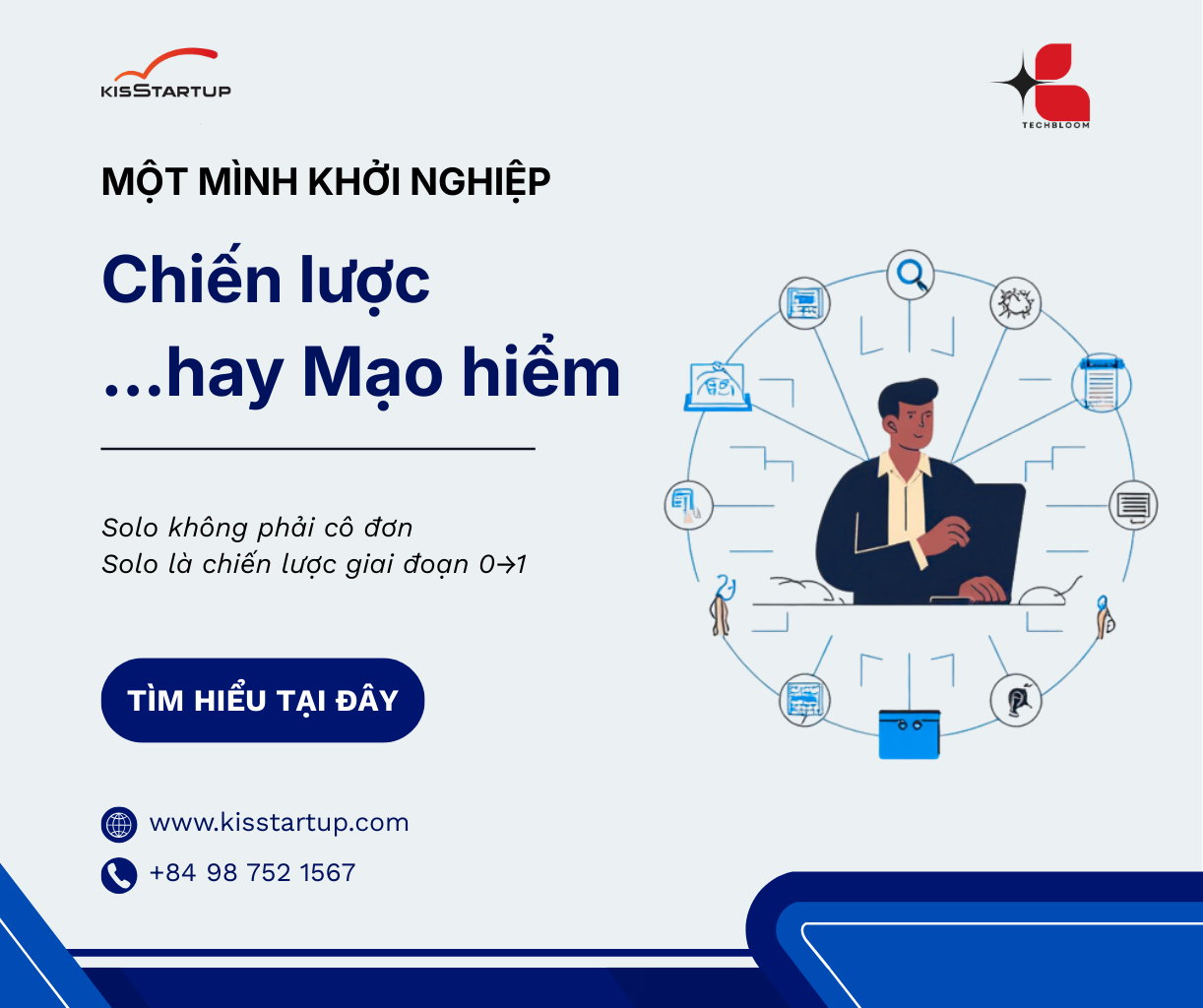
When Should You Choose to Be a Solo Entrepreneur?
1. When you command a crystal-clear vision and refuse "strategic compromise"
If you know exactly what you want to build, who it is for, and how to execute it—having a co-founder can slow down your decision-making. Going solo grants you high speed and execution consistency during the 0→1 phase.
Solo is best suited when:
- The problem is clearly defined and the niche is specific.
- There is no need for complex R&D that demands multiple parallel technical expertise.
- An MVP can be rolled out rapidly.
When you can leverage technology powerful enough to replace an "army of people"
In the era of AI and automation, a single founder can:
- Build products using no-code/AI tools.
- Drive marketing through content and automated email sequences.
- Handle customer success using advanced chatbots.
- Analyze finances via automated dashboards.
Being solo today is fundamentally different from a decade ago.
You can command a "virtual team" instead of a fixed payroll overhead.
When you want to validate the market before "marrying" someone
A co-founder relationship is akin to a marriage. Before committing long-term, many founders choose to:
- Build the prototype themselves.
- Personally close the first 10 to 50 customers.
- Deeply internalize the genuine market pain points.
Once you have established traction, you will know exactly what profile of co-founder you actually need.
When the business model perfectly fits a lean structure
Solo is highly optimized for:
- Small SaaS or Micro-SaaS models.
- Specialized AI tools.
- High-ticket consulting/coaching services.
- Knowledge businesses and the creator economy.
- Clear, niche e-commerce.
It is not suitable if:
- DeepTech demands diverse engineering disciplines (hardware, biotech, etc.).
- The startup needs to raise significant capital very early on.
- The business model heavily depends on multi-dimensional, complex networks.
But Going Solo Does Not Mean "Walking Alone"
Successful solo founders consistently build a robust ecosystem around themselves:
- Mentors
- Freelancers
- Advisory boards
- Communities
- Strategic early hires
They might not have a co-founder, but they are far from isolated.
The Greatest Risks for a Solo Founder
- Burnout.
- Strategic blind spots.
- A lack of constructive pushback/peer review.
- Sluggish scaling if they fail to utilize leverage.
Going solo demands fierce financial discipline, radical prioritization, and the capacity for rapid self-learning.
The TechBloom Mindset
At TechBloom, we frequently advise founders to audit themselves with 3 questions:
- Do I truly need a co-founder right now, or do I just need clarity?
- Am I lacking a skill set, or am I just lacking decisiveness?
- Have I validated the market sufficiently to justify diluting equity?
Going solo is not about being "lonely." Solo is a phase-specific strategy.
Countless founders start entirely on their own—but no one scales alone forever.
If you are weighing the decision to become a solo entrepreneur (whether in SaaS/AI, consulting, e-commerce, or a knowledge business), TechBloom is here to help you design a 0→1 roadmap custom-tailored to your unique context.
Build it right – before you build it big.