2026-06-17
Green coffee export – From consumer trends to the "new rules of the game" in global trade
For decades, the global coffee market has been shaped by volume, price, and productivity. However, in the past 5–10 years, a fundamental shift has taken place: "greening" is no longer an option, but a mandatory condition to enter the market.
From consumer preferences to policy pressure
The change started from consumers in developed markets such as the EU, the US, and Japan. Buyers are no longer just concerned about taste or cost, but ask deeper questions: where was the coffee grown, did it cause deforestation, were the farmers paid fairly, and what is the carbon footprint of the product? However, if it had stopped at a consumer trend, businesses could still "choose" whether to participate or not. The turning point lies in the fact that major markets have transformed this trend into mandatory legal regulations, typically the EU Deforestation Regulation (EUDR). This regulation requires imported coffee to prove that it is not linked to deforestation after 2020 and must be traceable down to each production land plot. This makes "green" a commercial standard, similar to quality or food safety standards in the past.
The coffee supply chain is being "rewritten"
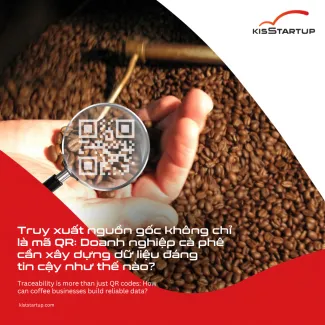
To meet the new requirements, the global coffee value chain is restructuring in three major directions. First is comprehensive traceability. Businesses can no longer just buy coffee from traders without knowing its origin. They are forced to build data systems for growing areas, GPS coordinates, cultivation history, and environment-related information. This triggers a wave of agricultural digitalization. Second is the transition to sustainable and regenerative agriculture. Cultivation models that reduce chemical use, increase ground cover, improve fertility, and conserve biodiversity not only help meet standards but are also ways to adapt to climate change. Third is standardization through international certification systems such as Organic, Fairtrade, Rainforest Alliance, 4C... These certifications become the "common language" that helps products be accepted in global trade.
Value no longer lies in the product, but in the "green story"
An important change is that the value of coffee no longer lies just in the coffee beans, but in the accompanying story: the story of environment, community, and responsibility. Coffee with clear traceability, sustainable production, and international certification can fetch significantly higher prices compared to mass-market coffee. This explains why many countries like Brazil, Colombia, or Vietnam are shifting from raw exports to higher-value product lines such as specialty coffee, roasted coffee, and instant coffee.
"Green" is not just a cost – it is a competitive strategy
A common mistake of businesses is viewing "greening" as an additional cost. In reality, in the current context, this is a condition to maintain markets and expand value. Businesses that take the lead in green transition not only retain the EU market but also leverage price advantages, build brands, and access green finance sources. Conversely, businesses that are slow to adapt risk being excluded from the global supply chain, not because of poor quality, but because they do not meet the "green passport" requirements.
Strategic implications for businesses
The green coffee export trend shows one clear thing: future competition will no longer be about volume or low costs, but about systems – data – and the ability to tell a sustainability story. Businesses need to perceive green transition not as a short-term project, but as a process of restructuring the entire business model, from raw material areas and production processes to market access strategies.
© Copyright by KisStartup. Any form of copying, quoting, or reusing must clearly credit KisStartup as the source.
- Log in to post comments
- 30 views